Why your armpits still smell after a shower
· 4 min read
You step out of the shower clean. By the time you've dried off and got dressed, you can smell it again. If that sounds familiar, you are not imagining it, and it is not about how well you wash.
Our sister lived with exactly this for years. It's why our mum made the first jar of what became MARL. So we know how tiring it is, and how little most advice helps. Here is what is actually going on, and what makes a difference.
Sweat doesn't smell. What happens to it does.
Your body makes two kinds of sweat. Most of it is watery and salty, and it cools you down. Under your arms there is a second kind, thicker and richer in proteins and fats. Both come out with almost no smell.
The smell appears when bacteria that live on everyone's skin break that thicker armpit sweat down. Researchers at the Universities of York and Oxford showed in 2018 that only a small number of these bacteria do it, turning an odourless substance in sweat into strong-smelling sulphur compounds (ESRF summary of the study). Those compounds are what you notice.
Why it comes back once you warm up
A shower washes away sweat and a good share of the bacteria on the surface. It doesn't remove all of them, and it isn't meant to: they are part of normal, healthy skin.
So the cycle starts again quickly. You dry off, get dressed, put the kettle on, and your underarms warm up. The first bit of sweat arrives, the bacteria that are still there get to work, and the smell is back. For some people that takes hours. For people with strong, stubborn sweat smell, it can take minutes.
That's why the smell so often shows up at the same moments: right after the shower, on the commute, on the school run, at the gym, or when you're nervous. Warmth and stress both bring out more of the thicker sweat.
Why it can smell stronger, or different, than before
- Stress. Stress sweat comes mostly from the glands that make the thicker sweat, so it tends to smell more.
- Hormones. The NHS lists hormonal changes as a common cause of body odour. Many women notice a change in perimenopause: we've written about menopause body odour separately.
- Food and drink. Strong-smelling or spicy food and a lot of alcohol can change how you smell. If yours smells like onions or curry, read why armpits can smell like onions.
- Clothes. Synthetic fabrics hold on to smell, even after a wash. When you warm up, the old smell can come back from the fabric, not your skin.
What helps
- Wash your underarms properly. Give them a few seconds of real attention with soap, not just a rinse.
- Dry them completely. Pat dry and wait a minute before you put anything on. Product on damp skin doesn't sit well.
- Use a clean towel. A towel that stays damp between uses can smell sour, and that ends up on you.
- Choose natural fabrics. The NHS suggests cotton, wool or silk, and avoiding tight clothes and synthetic fabrics.
- Deal with tops that hold smell. Wash them inside out, and retire the ones that still smell when you put them on.
- Pick a deodorant made for the problem. A deodorant works on smell; an antiperspirant reduces sweat. If smell is what bothers you, look for a deodorant made for strong odour rather than one that mostly adds fragrance.
When to see a GP
The NHS suggests seeing a GP if your body odour hasn't improved after trying things yourself and it's affecting how you feel about yourself, if it smells different from how it usually does, or if you've suddenly started sweating much more than usual (NHS: body odour).
Where MARL fits
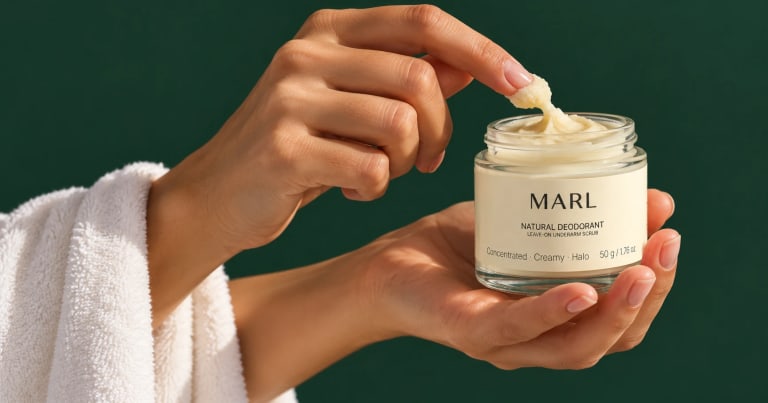
Our mum made MARL for our sister's smell, the kind that came back even after a shower. It's a balm with only seven ingredients and no baking soda. Alum stone and Nigella do the odour work, from the first morning, with no detox period.
Questions people ask
Should I put deodorant on straight after a shower?
Yes, once your underarms are completely dry. That's when it can sit on clean skin before the first sweat arrives.
Does shaving my armpits reduce the smell?
It can help a little for some people, because hair holds on to sweat and makes washing harder. It doesn't change the sweat or the bacteria, so it's rarely the whole answer.
Does it mean I'm not washing enough?
No. People with strong sweat smell often wash more than anyone. The smell comes from normal biology: sweat, skin bacteria and warmth. It isn't a sign of being unclean.